

Edmonton 1912: We Must Meet Apart
Tiny life stories in paper museums

In the early decades of the twentieth century the Montreal Star featured a classified advertising section called “Missing Relatives” for people trying to locate lost loved ones.
This is an occasional series about some of the missing people I have found.
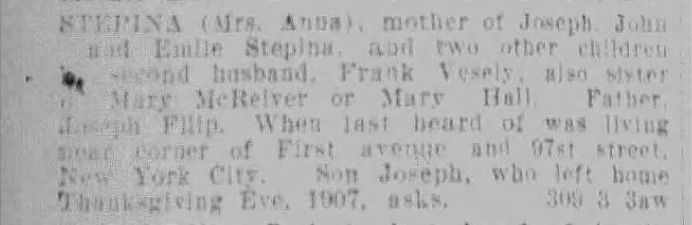
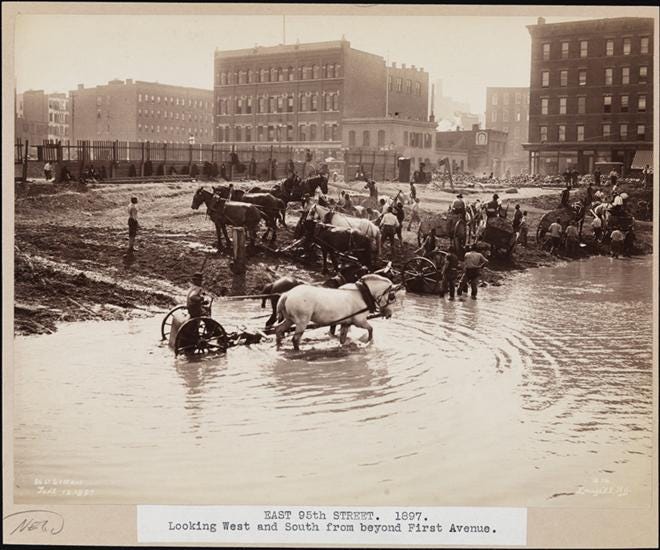
On the night before Thanksgiving 1907, seventeen-year-old Joseph Stepina walked out of his family’s apartment on First Avenue and 97th Street in New York City and never came back.
Until that night Joe had lived with his mother Anna and step-father, Frank Vesely. Anna and Frank were Czech immigrants, from what was then called Bohemia.
Eighteen-year-old Anna Filip arrived in New York in 1886. She soon met a fellow Czech named John (Jan) Stepina. They married in December of 1889. Their first child, Joseph, was born in September 1890. In 1900 Anna was a widow living on the Lower East Side and supporting herself as a cigar roller.1 Anna didn’t speak English and so had even fewer options than other widows with three small children.
At one time almost every Czech in New York was in the cigar business.2 Cigars were made by hand, most often by women and children in sheds, attics, and tenement rooms. They were made by people like Anna, who likely enlisted the children to meet her quota.
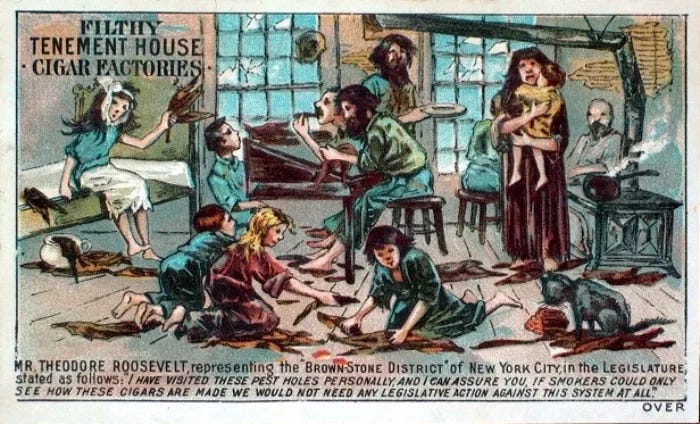
It was around 1900 when Anna met a carpenter and wheelwright named Frank Vesely, who was also Czech. She and Frank soon followed their compatriots to the Upper East Side, where 40,000 Czechs lived in the early decades of the 20th century alongside Germans, Hungarians and Slovaks.
Birth certificates for Anna’s children with Frank have John Stepina listed as father.3 Either John refused to divorce Anna, or he disappeared. If John did die, Frank may not have been legally able to marry Anna. They nevertheless lived as husband and wife, raising their children together until Frank’s death in 1917. 4
We don’t know what precipitated the events of November 27th,1907 in the Vesely household. Nobody plans to leave home the night before Thanksgiving. Had there been a fight? Did Joe storm out, or was he kicked out?
Although just a teenager, Joe had apprenticed first as a carpenter, then as an electric and steam engineer, the job of managing the coal-fired boilers that provided heat and electricity to New York City buildings. If Joe had paying work when he left home, it must have nevertheless been an unhappy winter, because that January he enlisted in the U.S. Army.5
Joe was assigned to the Coastal Artillery Corps but didn’t last long. He was discharged eight months later and spent the next few years kicking around. He found his way to Canada, then to the Michigan Upper Peninsula, where he manned the industrial boilers at the massive tannery of the Munisinger Leather Company.6 Joseph Stepina became “Joe Stephens.”
Somewhere in his travels Joe met a girl. Sarah Sager was from a small town in Ontario. She set out for Michigan to marry Joe in 1910. After two days, five train rides, and a ferry crossing she arrived alone at Munising for her wedding, where she did not reveal the names of her parents to the marriage registrar. Sarah was eighteen and Joseph was nineteen.7
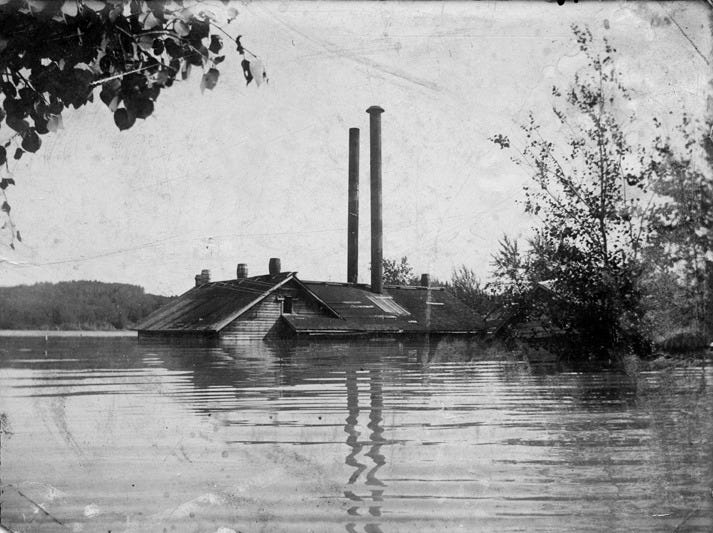
In 1911 they moved on to Edmonton, Alberta, where Joseph found work as an engineer in a power plant.8 That year they had a baby girl they named Anna, after Joe’s mother.9 Joe had not been in contact with his family since he walked out their apartment in New York that long-ago Thanksgiving. If he had written to Anna, his letters had been unanswered. Baby Anna was about 18 months old when Joe’s ad appeared in the Star.
What prompted Joe to do this? It seems unlikely that Sarah placed the ad.
Why did Joe choose “Missing Relatives” as the means to find his family? If he were looking for people last seen in New York City, why an ad in a Canadian newspaper?
Anna was still living in the place he had last seen her. If she had not answered a letter, why would Joe think she had gone missing? Joe grew up in the tight-knit “Little Bohemia” in the Yorkville section of the Upper East Side of Manhattan. Surely there were any number of people he knew in the old neighborhood who could confirm Anna’s whereabouts. He also had grown siblings still living in New York.
So many Missing Relatives ads have no practical information in them. Patrick Doyle left Ireland thirty years ago, believed to be in America. Sister inquires.
Some are so personal and cryptic that they can only be understood by the recipient. Come home, J.T., all is forgiven. No one reading the classifieds would know who J.T. is. But if J.T. happened to pick up the Montreal Star and browsed its back pages…
Such ads are simply cries into the void. Unless they serve a different purpose. Perhaps Joe wasn’t interested in finding Anna. At least, not this way. Perhaps he was doing something else.
A social historian looking at missing person ads can trace networks and migration patterns. Such ads can also be understood and analyzed as evidence of kinship and connection.
The ads are also perfect artifacts for a field of historical study known as “history of emotions,” which examines the varieties of emotional experience and expression in different cultures and eras. The starting assumption for historians of emotions is that feelings and the expression of feelings are not innate but culturally determined. For this reason, feelings and the way they are expressed have evolved throughout history.
The pioneer in this field was undoubtedly Lucien Febvre, whose 1941 essay “Sensibility and History” pointed out that historians had been ignoring a vast dimension of human experience, which was the emotional worlds of historical people. Reconstructing those worlds was essential to historical understanding.10
The missing person ad can be seen as one substrate in the history of emotions in which intensely private experiences are made public under the cover of another purpose. It’s also an emotional practice which the interlocutor is not only absent, but indeed must be absent. The ads often express feelings that must be shared, but cannot be shared directly with the person the feelings are about.
What can we infer about Joe’s feelings about Anna?
Joe identifies his mother by her former married name, Stepina, not her name for over a decade, found in censuses and directories, Mrs. Frank Vesely. He mentions his full siblings by name, not his half siblings, of which he mentions two, not three. There is a mention of an aunt.11 Classified ads charge by the word, even the character, but Joe spends extra money mentioning he left the night before Thanksgiving, an unnecessary detail for the apparent task of finding his mother.
Joe is sharing a memory. Possibly an expression of guilt and regret. Or nostalgia and homesickness. It could be an act of mourning. Did he forgive his mother, or wish to be forgiven? Joe’s ad could be a public declaration of loyalty. Anna had not been forgotten or abandoned. Her son was still searching for her.
Where does this ad fit into our culture’s emotional history? The impulse to share with strangers is not new. In the days before social media there were other means for airing personal feelings and public confession. Classified ads were only one such outlet.
Advice columns were another newsprint public square. Since the nineteenth century newspapers had “agony aunt” columns where readers could anonymously recount failed marriages, unwed pregnancies, alcoholism, personal feuds, and forbidden loves. The advice itself was often secondary. The column was the means for ordinary people to tell their story in public.
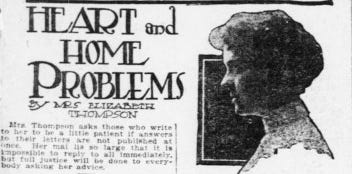
Not all of these public statements were anonymous. Editorials and letters to the editor were also personal soapboxes. Court proceedings and police court blotters were another way for people to accuse one another of wrongdoing or air grievances.
Religious testimony in revival meetings or other church settings encouraged public confession of sin for redemption. It was a socially acceptable way to share deeply personal experiences in public.
Late in the 20th century came call-in radio shows, daytime tabloid talk shows, 900 number party lines, and hotlines like 1-800-CONFESS.
All of this of course a mere prelude to the current unhinged nonstop exhibitionism of the internet.

If we think about emotions and their expression as having a history, the emergence of the novel and personal memoir in the modern age was a new way to represent interior life. The compressed memoir of the newspaper personal ad is its weird step- cousin: a mutation in the culture of self-expression. “Missing Relatives” ads are miniature narratives in which ordinary people condense a lifetime of love or grief into a few lines of print.
The rest of Joe’s life does not tell us whether he and his mother were ever reunited.
Joe had left the power plant and was working as a farmer in rural Alberta when he volunteered for the Canadian Expeditionary Force in the summer of 1916.12 Joe and Sarah were part of a homesteading boom in rural Alberta in these years, with a great number of settlers moving in. Joe’s motive for enlisting is not clear, but the hard climate and short growing season of northern Alberta discouraged all but the most skilled and fortunate farmers.
By this time, Joe and Sarah had three little girls under six. Sarah and the children could not survive on the $15 a month Joe sent home, so she returned to live with her family in Ontario.13 In January 1919 Sarah attempted to cross the border with the idea she would stay with her mother-in-law Anna in New York City.
Had she been invited? Or had Sarah outworn her welcome with her own family? Joe may have reconnected with his mother, or Sarah may have simply had a hunch Anna was still in the old neighborhood. Sarah did not have compelling proof she had a place to go, because she and her girls were turned away at the border at Buffalo with the initials “LPC.” Liable to be Public Charge.14
Joe was spared the trenches. No doubt because of his work clearing land in Alberta he was assigned to the Canadian Forestry Corps, logging trees in the far north of Scotland for trench flooring, dug-out shelters, and railway ties.15 It was not combat, but it was dangerous, grueling work.
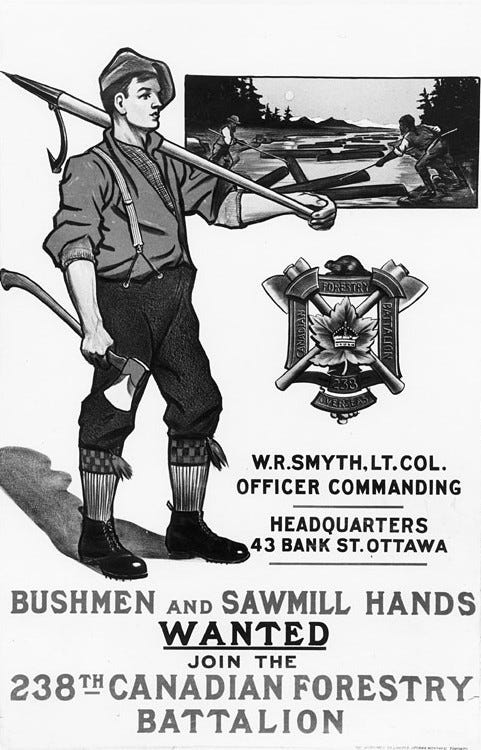
The war left its mark on Joe in other ways. After the Armistice soldiers were mired in an endless wait to go home. Joe was transferred to the camp at Kinmel Park in Rhyl, Wales, which had become a miserable grey limbo for tens of thousands of Canadian soldiers: half rations and huts so crowded the men took turns sleeping on the floor. A few weeks after Joe’s arrival, frustration boiled over into violence. When the mutiny was over, twenty four men were dead. 16
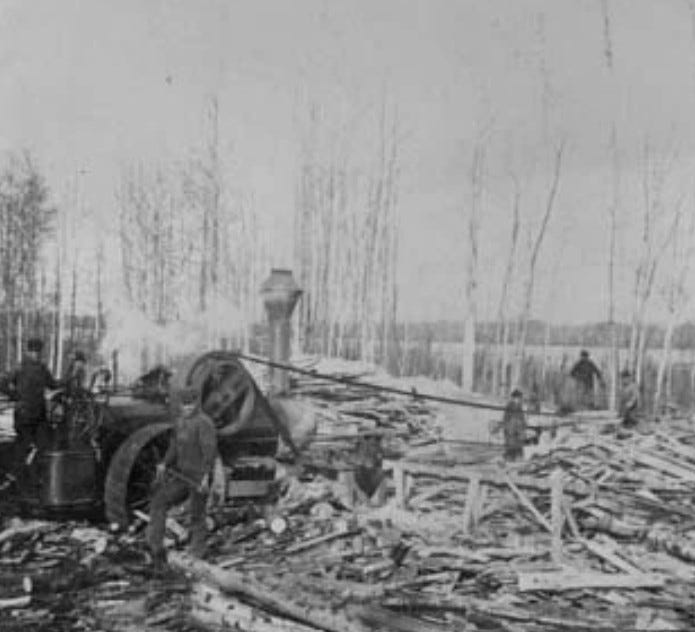
Joe and Sarah had applied for a soldier’s land grant and after the war Joe was deeded 160 acres of uninhabited Crown Land twelve miles south of Athabaska, Alberta, in a place called Bleak Lake.17
Joe’s tract was thick with aspen and poplar broken only by muskeg that could suck a man up to his waist in cold, watery decay. When he saw it he knew he was condemned to many more years of cutting trees, burning brush, and pulling stumps.
Sarah stayed away from the house for extended periods. She had discovered she’d come home to a violent stranger. One day he tried to choke her. When Sarah pressed charges, Joe claimed she was the one who had changed; her assault charge was to extort money from him. He said he was through.18 Joe abandoned the homestead at Bleak Lake, left his family, and lived on his own farming in nearby Grosmont. 19
The Stepinas eventually reunited. We can only speculate whether Joe’s rage was wartime PTSD. They went on to have six more children.
In 1929 the family wrote off twenty years trying to make a go of it in Alberta and headed west. They had company: three quarters of a million farms were abandoned across the Canadian Prairies during the Depression, pushed out by drought and foreclosure.
The Stepinas settled in Vancouver, where Joe found work as a millwright. But Joe always wanted to be his own man. It wasn’t long before he decided to strike out on his own again, gold prospecting in Cariboo, British Columbia.
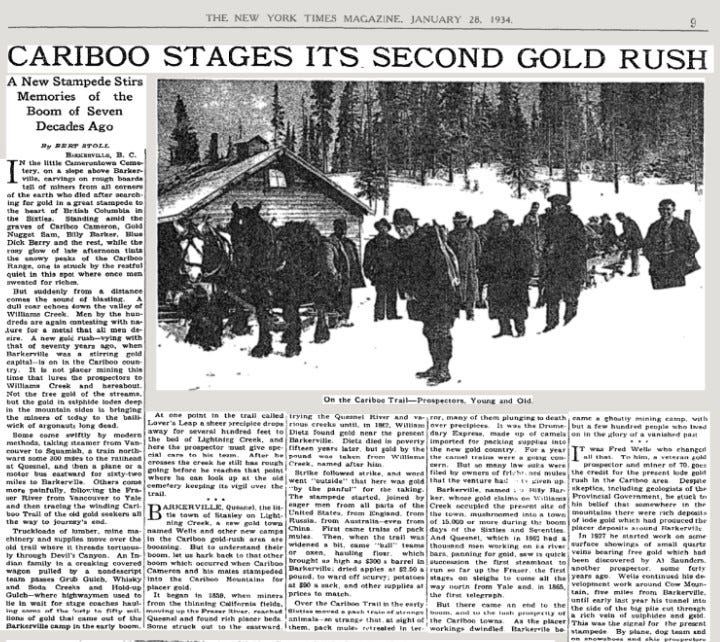
The Cariboo Gold Rush had been over for almost sixty years. In the 1930s unemployed desperate people flocked to its worked-out mountains to pan for phantom gold.
Joe was at his mining claim in the spring of 1940 near Hardscrabble Creek when a fallen boulder crushed his leg. He bled out on a remote hillside. He is buried in Cariboo.20
Why did Joe place this ad looking for his mother? We don’t know. Maybe, simply: he remembered her.
The person he remembered was not Anna Vesely, but Anna Stepina, the young impoverished cigar roller he didn’t have to share with anyone, except his little brother and sister, and maybe a beloved aunt.
Adult Joe remembers seven-year-old Joe, skipping school to meet his mother’s cigar quota, dreaming of the day he could get a job. He remembers when she called him “the man of the house.”
He remembers her tales of the mountains of Bohemia, and of the giant ocean vessel that brought her to New York, and how he told himself he would travel, too.
He remembers his family, his neighborhood, and the night he left the house. But above all, he remembers Anna.
She died in 1937, at the age of 68, still living on First Avenue, in the old neighborhood.
Ancestry.com. New York, U.S., Arriving Passenger and Crew Lists (including Castle Garden and Ellis Island), 1820-1957 [database on-line]. Lehi, UT, USA: Ancestry.com Operations, Inc., 2010. https://www.ancestry.com/search/collections/7488/records/10787398?tid=&pid=&queryId=0e7a8eac-a9c8-4ae4-8143-0f96fd610fcb&_phsrc=pFP10418&_phstart=successSource Retrieved July 17, 2026
Ancestry.com. New York, New York, U.S., Extracted Marriage Index, 1866-1937 [database on-line]. Provo, UT, USA: Ancestry.com Operations, Inc., 2014. https://www.ancestry.com/search/collections/9105/records/1107953?tid=&pid=&queryId=93a0c356-9107-4a59-bf52-94954dd396ee&_phsrc=pFP10426&_phstart=successSource Retrieved July 17, 2026
Ancestry.com. New York, New York, U.S., Index to Birth Certificates, 1866-1909 [database on-line]. Lehi, UT USA: 2020. https://www.ancestry.com/search/collections/61779/records/2247526?tid=&pid=&queryId=0014755a-3b17-4899-8076-dfb1e3ea027a&_phsrc=pFP10429&_phstart=successSource Retrieved July 17, 2026
Ancestry.com. 1900 United States Federal Census [database on-line]. Lehi, UT, USA: Ancestry.com Operations Inc, 2004. https://www.ancestry.com/imageviewer/collections/7602/images/4114681_00775?queryId=123edb96-66b0-4034-a5f2-019b5455d58f&usePUB=true&_phsrc=pFP10448&_phstart=successSource&usePUBJs=true&pId=67016729 Retrieved July 17, 2026
Czech cigar making was a bit of New York history I knew nothing about. https://english.radio.cz/czech-new-york-pt-1-new-book-shines-light-fascinating-history-8712677 Retrieved July 17, 2026
Ancestry.com. New York, New York, U.S., Index to Birth Certificates, 1866-1909 [database on-line]. Lehi, UT USA: 2020. https://www.ancestry.com/search/collections/61779/records/2676021?tid=&pid=&queryId=a243efaf-a4c1-4e41-9e2b-bd7295dc516a&_phsrc=pFP10401&_phstart=successSource Retrieved July 17, 2026
Ancestry.com. New York, U.S., State Census, 1905 [database on-line]. Lehi, UT, USA: Ancestry.com Operations, Inc., 2014. https://www.ancestry.com/imageviewer/collections/7364/images/004518323_00538?usePUB=true&usePUBJs=true&pId=5416515 Retrieved July 17, 2026
Ancestry.com. U.S., Army, Register of Enlistments, 1798-1914 [database on-line]. Lehi, UT, USA: Ancestry.com Operations Inc, 2007 https://www.ancestry.com/search/collections/1198/records/1254548?tid=&pid=&queryId=dc59ee6d-3f5a-4d17-840b-4d8c6dee3ca3&_phsrc=pFP10436&_phstart=successSource Retrieved July 17, 2026
Ruth Ann Harris has studied 90 years of Irish immigrant "Missing Friends” ads (1831-1920) Boston Pilot, which are a rich source for reconstructing migration paths, communities, and the experience of immigration. An archive of over 40,000 such ads have been put into a public online database for anyone researching their Irish family history. An incredible act of service of potential benefit to historians and anyone looking for Irish ancestors! https://dataverse.harvard.edu/dataset.xhtml?persistentId=doi:10.7910/DVN/UNJU3N
Ancestry.com. Michigan, U.S., Marriage Records, 1867-1952 [database on-line]. Provo, UT, USA: Ancestry.com Operations, Inc., 2015 https://www.ancestry.com/search/collections/9093/records/506997?tid=&pid=&queryId=f15467ec-23ce-43cb-a352-23396b6e8960&_phsrc=pFP10445&_phstart=successSource. Retrieved July 17, 2026
Ancestry.com. 1911 Census of Canada [database on-line]. Provo, UT, USA: Ancestry.com Operations Inc, 2006.
https://www.ancestry.com/search/collections/8947/records/7264150?tid=&pid=&queryId=dbffe55a-373a-4b72-9cb0-a2d2bed01694&_phsrc=pFP10452&_phstart=successSource Retrieved July 17, 2026
Ancestry.com and The Church of Jesus Christ of Latter-day Saints. 1916 Canada Census of Manitoba, Saskatchewan, and Alberta [database on-line]. Provo, UT, USA: Ancestry.com Operations Inc, 2009.
https://www.ancestry.com/imageviewer/collections/1556/images/31228_4363983-01184?usePUB=true&usePUBJs=true&pId=759887284 Retrieved July 17, 2026
Febvre, Lucien. “Sensibility and History: How to Reconstitute the Affective Life of the Past.” A New Kind of History: From the Writings of Febvre, edited by Peter Burke, Harper & Row,1973.
I couldn’t find records of anyone matching this person.
Ancestry.com and The Church of Jesus Christ of Latter-day Saints. 1916 Canada Census of Manitoba, Saskatchewan, and Alberta [database on-line]. Provo, UT, USA: Ancestry.com Operations Inc, 2009.
https://www.ancestry.com/imageviewer/collections/1556/images/31228_4363983-01184?usePUB=true&usePUBJs=true&pId=759887284 Retrieved July 17, 2026
Ancestry.com. Canada, World War I CEF Personnel Files, 1914-1918 [database on-line]. Lehi, UT, USA: Ancestry.com Operations, Inc., 2016.
https://www.ancestry.com/imageviewer/collections/61084/images/b9279-s017-0001?usePUB=true&usePUBJs=true&pId=962493 Retrieved July 17, 2026
"United States records," images, FamilySearch (https://www.familysearch.org/ark:/61903/3:1:9392-XW9V-G7?view=explore : Jul 17, 2026), image 2193 of 5468; United States. National Archives and Records Administration. Image Group Number: 004720317
https://www.familysearch.org/ark:/61903/3:1:9392-XW9V-G7?view=index&personArk=%2Fark%3A%2F61903%2F1%3A1%3AQV9W-FVMR&action=view&cc=1876434&lang=en Retrieved July 17, 2026
Ancestry.com. Canada, World War I CEF Personnel Files, 1914-1918 [database on-line]. Lehi, UT, USA: Ancestry.com Operations, Inc., 2016.
https://thecanadianencyclopedia.ca/en/article/kinmel-park-riot Retrieved July 17, 2026
Ancestry.com. Alberta, Canada, Homestead Records, 1870-1930 [database on-line]. Provo, UT, USA: Ancestry.com Operations, Inc., 2016. https://www.ancestry.com/imageviewer/collections/60865/images/albertahomestead3010cana_0439?usePUB=true&usePUBJs=true&pId=150493 Retrieved July 17, 2026
The news article reports that Joseph returned home to a wife he did not recognize. That she was no longer “the good wife” she’d been before, not only absent from home but failing to cook for him and neglecting the house. While it’s possible Sarah had changed in his absence, we can infer that his war experiences had changed Joseph, too. “Assault Charge is Laid By Wife Against Husband” Edmonton Bulletin, July 29, 1919. https://www.newspapers.com/image/738143903/?match=1&terms=Stepina Retrieved July 17, 2026 via Newspapers.com
Ancestry.com. 1921 Census of Canada [database on-line]. Provo, UT, USA: Ancestry.com Operations Inc, 2013.
https://www.ancestry.com/imageviewer/collections/8991/images/1921_005-E002858035?queryId=32325a37-be62-49be-8071-fb96b6fc0270&usePUB=true&_phsrc=pFP10459&_phstart=successSource&usePUBJs=true&pId=7151181 Retrieved July 17, 2026
“Prospector Meets Tragic End” Quesnel Observer, May 4, 1940. https://www.newspapers.com/image/686210823/?match=1 Retrieved July 17, 2026 via Newspapers.com
This was both fascinating and moving, Lisa. A reminder never to take sources at face value. Have you come across Katie Barclay’s work on the history of emotions? I met her some years ago through a research project she was involved with. (And great to see a mention of the forestry brigade commanded by my grandmother’s uncle William!)
You have to look up Forverts "Gallery of Missing Husbands" (and from there, the National Desertion Board) - it's such an interesting phenomenon!